


Legal Framework
United Nations and United Arab Emirates Sanctions Legal Framework
The United Nations Security Council (UNSC) holds the capacity to take action in seeking to maintain or restore international peace and security under Chapter VII of the United Nations Charter, including by imposing sanctioning measures under Article 41, which encompass a broad range of enforcement options that do not involve the use of armed force, including interruption of economic relations, international communications, and diplomatic relations.
The Security Council sanctions regimes focus mainly on supporting the settlement of political conflicts, nuclear non-proliferation, and counterterrorism. These regimes include measures ranging from comprehensive economic and trade sanctions to more targeted measures such as arms embargoes, travel bans, and restrictions on dealing with certain financial or commodity transactions.
The United Arab Emirates (UAE), as a member of the United Nations (UN), is committed to implement the United Nations Security Council Resolutions (UNSCRs), including those related to UN sanctions regimes. Consequently, through the Cabinet Decision No. 74 of 2020, the UAE is implementing UNSCRs on the suppression and combating of terrorism, terrorist financing & countering the financing of proliferation of weapons of mass destruction, in particular Targeted Financial Sanctions (TFS) regimes as defined by the UN. Persons should note that, in accordance with the laws of the UAE, the UAE Government also applies TFS by publishing a UAE Local Terrorist List in accordance with UNSCR 1373 (2001), which calls for Member States to publish their own national terrorist lists.
TFS are implemented in the UAE pursuant to UNSCRs in relation to:
Terrorism and Terrorist Financing
|
1. Islamic State in Iraq and the Levant (Da'esh), Al-Qaida, and associated individuals, groups, undertakings, and entities. |
UNSCR 1267 (1999), 1989 (2011) and its successor resolutions |
|
2. The Taliban, and associated individuals, groups, undertakings, and entities. |
UNSCR 1988 (2011) and its successor resolutions |
|
3. Any individual or entity included in the Local Terrorist List, pursuant to UNSCR 1373 (2001) |
|
|
4. Al-Shabaab Sanctions Committee |
The Proliferation of Weapons of Mass Destruction (WMD)
|
1. Democratic People's Republic of Korea (DPRK): nuclear-related, other weapons of mass destruction-related and ballistic missile-related programs. |
UNSCR 1718 (2006) and its successor resolutions |
|
2. Islamic Republic of Iran |
UNSCR 1737 (2006) and its successor resolutions |
Other UN sanctions regimes with TFS
|
1. Iraq |
|
|
2. The Democratic Republic of Congo (DRC) |
|
|
3. Sudan |
|
|
4. Lebanon |
|
|
5. Libya |
|
|
6. Guinea-Bissau |
|
|
7. Yemen |
|
|
8. South Sudan |
|
|
9. Haiti |
|
|
10. Central African Republic (CAR) |
Related Links
Sanctions Committee websiteLocal Terrorist List
Overview
All United Nations (UN) member states must implement freezing measures with regards to individuals, entities and groups designated by the United Nations Security Council (UNSC). In addition, UNSC Resolution 1373 (2001) mandates each UN member state to develop the procedures to identify and designate individuals, entities or groups that are suspected of, attempt to, and/or commit terrorist acts, and apply freezing measures on them.
The Supreme Council for National Security (Supreme Council) in the UAE prepares such designations and each listing must be approved by the Cabinet of the UAE. Specifically, the Supreme Council proposes a Local List that meets the designation criteria under UNSC Resolution 1373 (2001). The Supreme Council can include individuals, entities or groups in the Local List without prior notice to the designated person, and irrespective of whether criminal proceedings exist.
International Cooperation Pursuant UNSCR 1373 (2001)
- Sending a designation request
The Supreme Council may unilaterally request a foreign country to designate an individual or entity that meets the criteria for listing under UNSC Resolution 1373 (2001). The listing proposal may include the following:
- Specific information establishing links to terrorist individuals, entities or groups or otherwise establishing that the individuals, entities or groups meet the designation criteria.
- Evidence or documents supporting the listing proposal, such as reports of law enforcement authorities, intelligence agencies, the judiciary, or others.
- Receiving a designation request
Any foreign country may request the Supreme Council to include in the Local List an individual, entity or group that is suspected or believed to meet the designation criteria under UN Security Council Resolution 1373 (2001).
The Supreme Council shall determine whether the request meets the designation criteria. If so, the request is presented to the UAE Cabinet for consideration and decision.
- Updating & Re-listing
The Supreme Council conducts periodic reviews of the Local List, in coordination with the Ministry of Justice and based on information from Law Enforcement Authorities (LEAs) and other relevant agencies in the UAE.
If the Supreme Council considers that there are no longer reasonable grounds to believe that an individual, entity or group in the Local List meets the designation criteria, the Supreme Council shall propose de-listing that individual, entity or group from the Local List and de-listing occurs following approval by the UAE Cabinet.
Documents
UNSC Resolution 1373
- , 105.3 KB
Sanctions Implementation
Overview
Targeted Financial Sanctions (TFS) must be implemented in accordance with Cabinet Decision No.74 of 2020 and the relevant UNSC Resolutions, which include the UN Consolidated List and the Local Terrorist List (collectively referred to as ‘Sanctions List’).
Article 21 of Cabinet Decision 74 of 2020 has set the main TFS obligations on Financial Institutions, Designated Non-Financial Businesses and Professions, and Virtual Assets Service Providers (Reporting Entities). The four main obligations are as follows:
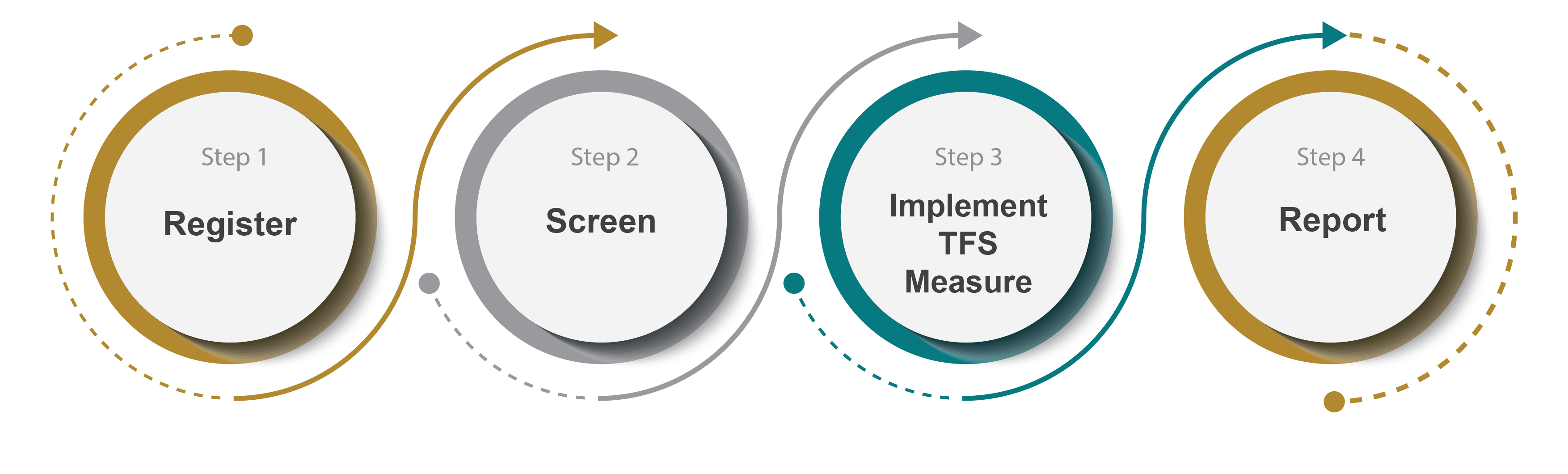
- Step 1 - Register: Reporting Entities are required to register (Click Here) to the Notification Alert System (NAS) on the EOCN’s website to receive automated email notifications on any updates to the Sanctions Lists.
- Step 2 - Screen: Reporting Entities must undertake regular and ongoing screening on the latest Sanctions Lists. In addition to registering on the EOCN NAS to receive alert updates, Reporting Entities should also check the UN website for press releases regularly to remain vigilant on any updates to UN Sanctions Lists.
Screening must be undertaken in the following circumstances:
- Upon any updates to the Sanctions Lists. In such cases, screening must be conducted immediately to ensure compliance with implementing freezing measures without delay (within 24 hours).
- Prior to onboarding new customers.
- Upon periodic KYC reviews or if there is a material change in the nature or ownership of the customer.
- Before processing any transaction of a counterparty.
- Step 3 - Implement TFS Measures:
1) Freeze all funds or other assets without delay (within 24 hours) and without prior notice to the designated individual, entity, or group:
- Owned or controlled, wholly or jointly, directly, or indirectly, by an individual, entity, or group designated in the Sanctions Lists.
- Derived or generated from funds or other assets under item (a); or
- Any individual or entity acting on behalf of or at the direction of any designated individual, entity, or group.
2) Prohibition from making funds or other assets or services available: Reporting Entities are prohibited from providing funds or other assets to or rendering financial or other services related to, whether in whole or in part, directly or indirectly, for the benefit of any designated individual, entity, or group on the Sanctions Lists.
Important Note: The obligations to freeze without delay shall not prevent additions to frozen accounts of:
- Interest, profits, or other earnings due on the account; or
- Payments due under contracts, agreements or obligations agreed upon prior to the date on which the account has become subject to freezing, provided such additions are immediately frozen.
Lifting of Freezing Measures
Freezing applied as a result of TFS measures have no time limit. Asset freezes remain valid until one of the following occurs:
- The designated Person is delisted (removed) from the Sanctions Lists. Upon delisting, all TFS measures are to be lifted immediately without prior approval from EOCN or the relevant Supervisory Authority, unless there is an active Freeze Order related to the delisted Person issued by a Competent Authority (FIU, Public Prosecution, etc.)
- A freezing cancellation decision by EOCN is communicated to the Reporting Entity through goAML.
- Step 4 - Report: The mechanism to report any TFS measures taken upon identifying a Confirmed or Partial Name Match is through submitting one of the following two reports via goAML:
- Confirmed Name Match Report (CNMR); or
- Partial Name Match Report (PNMR).
For non goAML users (Persons that do not fall under the definition of FIs, DNFBPs, or VASPs and are therefore not under an obligation to register on goAML), the reporting should be made by sending an email to the EOCN through tfs@eocn.gov.ae within five (5) business days from taking such measures.
Who is the target of these measures?
The freezing measures, including the prohibition of making funds or other assets or services available, apply to the following targets:
- Any individual, entity, or group designated in the UAE Local Terrorist List issued by the UAE Federal Cabinet or in the UN Consolidated List issued by the UNSC.
- Any entity directly or indirectly owned or controlled by an individual, entity, or group designated under (a).
- Any individual or entity acting on behalf of or at the direction of any individual, entity, or group designated under (a) & (b).
Important Note:
Reporting Entities are obligated to apply freezing measures on entities which are majority owned by designated individuals or entities.
In implementing TFS, the criterion to be taken into account when assessing whether a legal entity is majority owned by a designated individual or entity is the possession of more than 50% of the proprietary rights of the legal entity or having a controlling interest in it. If this criterion is satisfied, it is considered that the legal entity or arrangement is owned by another individual or entity and is subject to freezing measures.
Reporting Entities should apply freezing measures in cases in which a designated Person holds a minority interest, if there is evidence that the designated Person exerts control over the legal entity (despite owning a minority interest). The criteria to be taken into account when assessing whether a legal entity is mainly controlled by another Person, alone or pursuant to an agreement with another shareholder or other third party, is mentioned in the Guidance on Targeted Financial Sanctions published by the EOCN.
How to identify a match to apply TFS?
Reporting Entities in the UAE must continuously screen their customers, potential customers, beneficial owners, and transaction parties to identify possible matches to the Local Terrorist List or UN Consolidated List.
The Sanctions Lists contain a range of information to aid the identification of designated individuals, entities, or groups during the screening process. If none of the key identifiers match, then the screening result is considered a “Negative Match”.
The following are examples of the key identifiers:
|
For Natural Persons |
For Legal Persons |
|
Individual’s Name Date of Birth Nationality ID or Passport Number Last Known Address |
Entity or Company’s Name Trade License Number Address of Registration Address of Branches |
There are four possible results following the screening process, as listed below:
|
Screening Result |
Definition |
Examples |
|
Confirmed Name Match |
A Confirmed Name Match is when an individual, entity, or group matches all the key identifiers published on the UAE Local Terrorist List or UNSC Consolidated List. |
Your customer’s name, nationality, and DOB fully match with the identifiers of a designated Person in the UAE Local Terrorist List or UNSC Consolidated List. |
|
Partial Name Match |
A Partial Name Match is when there is a partial match between the key identifiers in the UAE Local Terrorist List or UNSC Consolidated List and a customer’s information in your database, and you are unable to conclude a False Positive or a Confirmed Name Match. |
Your customer’s name and DOB match with the identifiers of a designated Person in the UAE Local Terrorist List or UNSC Consolidated List, but the nationality is different and there is a slight difference in the name spelling. |
|
False Positive |
A False Positive is a match to listed individuals, entities, or groups, which upon examination of key identifiers, such as full name, DOB, and nationality, proves not to be the designated individuals, entities, or groups. |
Your customer’s name matches with a designated Person who is 40 years old according to the DOB identifier in the UAE Local Terrorist List or UNSC Consolidated List, but your customer is a 16-year-old high school student. |
|
Negative Match |
A Negative Match is when no match is identified upon conducting screening. |
You have conducted screening following a designation on the UAE Local Terrorist or UNSC Consolidated List and neither a Confirmed nor a Partial Name Match was identified. |
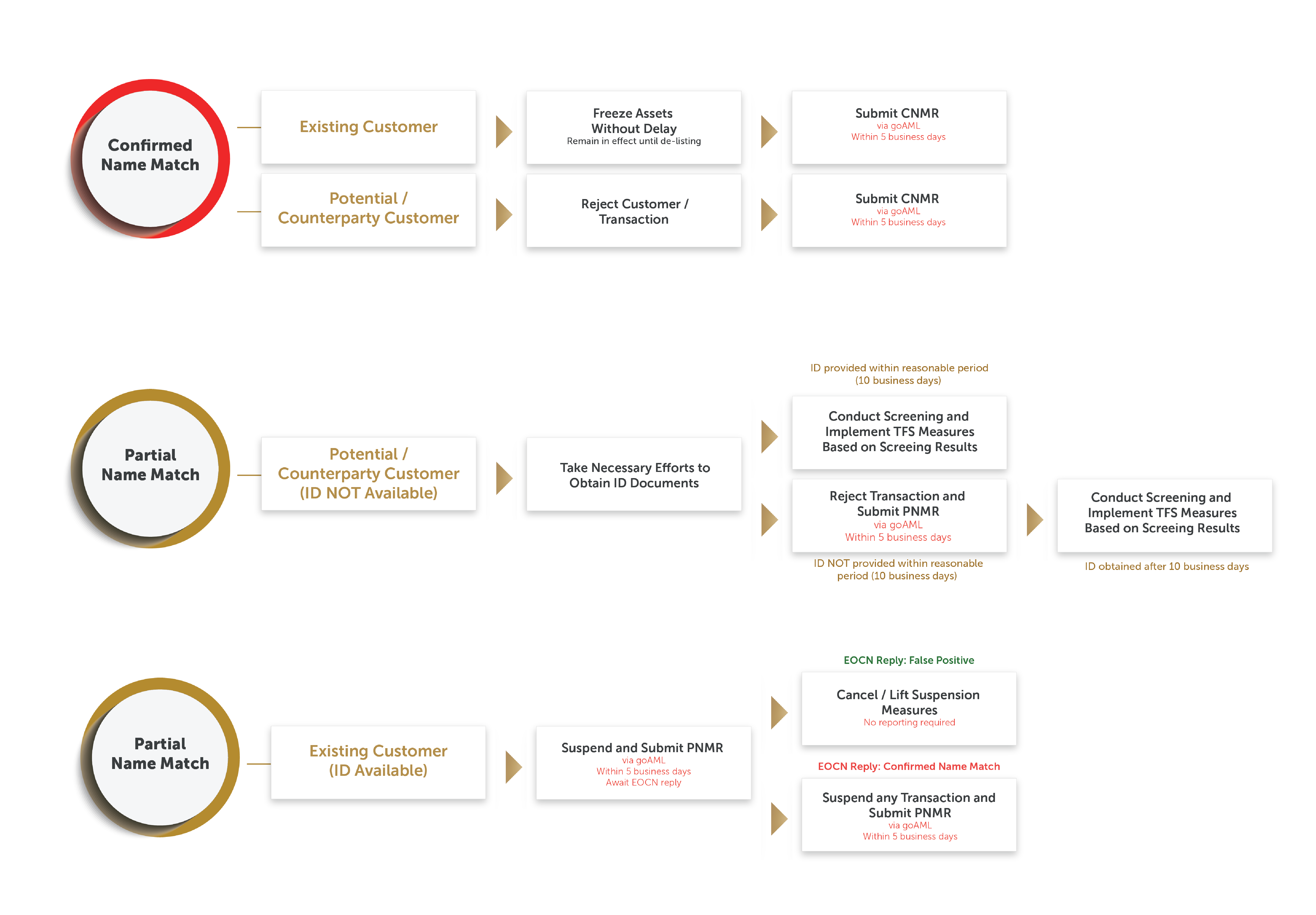
If the individual, entity, or group matches all the key identifiers published on the Sanctions Lists, then the result is considered a ‘Confirmed Name Match’. In case the Confirmed Name Match is an existing customer, you must freeze immediately without delay, refrain from offering any funds or other assets or services and submit a Confirmed Name Match Report (CNMR) detailing the freezing measures to the EOCN and the relevant Supervisory Authority (SA) through the goAML platform within five business days from taking any freezing measure. In case the Confirmed Name Match is a potential customer (a prospective client), you must reject the transaction immediately and submit a CNMR.
If you identify a partial match between the identifiers in the UAE Local Terrorist List or UNSC Consolidated List and a customer’s information in your database, and you are unable to verify the match (Confirmed Name Match or False Positive), then the result is considered a ‘Partial Name Match’. In this case, you must either suspend the transaction immediately without delay, refrain from offering any funds or other assets or services or reject the transaction and submit a PNMR to the EOCN and the relevant SA through the goAML platform within five business days from rejecting the transaction or any suspension measure taken.
In case a match is identified, and upon examination of key identifiers, you’re able to conclude that the match is not the designated individual, entity, or group, then the result is considered a ‘False Positive’. In this case, no reporting is required; however, internal documentation on the False Positive result should be maintained.
In cases of weekends and public holidays, Reporting Entities should have appropriate internal procedures to effectively screen against the UAE Local List and the UNSC Consolidated List and prevent access or use of funds or other assets that may be subject to freezing measures. If the Reporting Entity is not conducting any business activities or transactions and where customers do not have access to any assets or accounts during weekends or holidays, then the screening obligation starts from the first minute of commencement of business and freezing measures must be applied immediately. In any case, Reporting Entities should ensure that funds or other assets subject to TFS measures are prevented from being accessed or used.
Other Measures
UNSCRs and Cabinet Decisions may include other sanctions measures, such as travel bans, arms embargoes, and restrictions on dealing with certain financial or commodities transactions. Competent authorities should implement these measures as well.
Enforcement Measures
Any person who violates the instructions issued by the Executive Office or any other Competent Authority related to Targeted Financial Sanctions shall be punished with imprisonment and a fine of not less than twenty thousand dirhams (AED 20,000), or by either of these two penalties, as stated under Article (33) of Federal Decree by Law No. 10 of 2025 Regarding Anti-Money Laundering, and Combating the Financing of Terrorism and Proliferation Financing.
In addition, Reporting Entities are subject to supervision, and in the case of identified non-compliance, the SA can apply the enforcement actions set out under Article (17) of Federal Decree by Law No. 10 of 2025 Regarding Anti-Money Laundering, and Combating the Financing of Terrorism and Proliferation Financing.
Exemption from Liability in Case of Good Faith TFS Implementation
Any Person who, in good faith, freeze funds or other assets, or refuses to provide financial services to designated individuals, entities, or groups in compliance with the provisions of Cabinet Decision No. 74 of 2020 shall be exempt from any damages or claims, resulting from such actions, including penal, civil, and/or administrative liability.
- Amend of 17 Names on Sanction Committee 1988
- Addition of Four Names on Sanction Committee 1591
- Amend of three names on Sanction Committee 1988
- Amend of four names on Sanction Committee 1988
- Addition of One Entry From ISIL Daesh and AlQaida Sanctions Committee
- Amends twenty two Names on Sanctions Committee Taliban on 11 March 2026
- Removal of One Entry From ISIL Daesh and AlQaida Sanctions Committee
- Adding Four Entries on Sanction Committee 1591
- Remove One Entry on Sanction Committee 1518 Concerning Iraq
- Amending One Entry to ISIL Daesh and AlQaida Sanctions Committee
- Amending one Entry to ISIL Daesh and AlQaida Sanctions Committee
- Amending Two Entries to ISIL Daesh and AlQaida Sanctions Committee
- Amending Five Entries to ISIL Daesh and AlQaida Sanctions Committee
- Ammending One Entry on Sanction Comittee 1518 Concerning Iraq
- Adding Two Entries on Sanction Committee 2653 Concerning Haiti
- Adding One Entry from ISIL Daesh and AlQaida Sanctions Committee
- Removes One Entry from ISIL Daesh and AlQaida Sanctions Committee
- Cabinet Resolution No 44 to 2025 Adding Entries on Local Terrorist List
- Amending Twelve Entries on Sanctions Committe ISIL Daesh and Al Qaida
- Removes One Entry from ISIL Daesh and AlQaida Sanctions Committee
- Cabinet Resolution No 1 to 2025 Adding Entries on Local Terrorist List
- Remove One Entry from Sanction Committee of Libya 1970
- Amending Three Entries on Sanctions Committee ISIL Daesh and AlQaida
- Adding Two Entries on Sanction Committee of The Sudan 1591
- Adding Two Entries on Sanction Committee of Haiti 2653
- Amending One Entry on Sanction Committee 1718 DPRK
- Remove One Entry on Sanction Committee ISIL Daesh and AlQaida
- Remove Two Entries from Sanction Committee of Yemen 2140
- Adding 3 Entries on Sanction Committee 2713 concerning Al Shabaab
- Cabinet Resolution No 48 to 2024 delisting One Entry from local terrorist list
- Amending One Entry on Sanction Committee ISIL Daesh and AlQaida
- Amending One Entry on Sanction Committee 1718 DPRK
- Cabinet Resolution No 24 to 2024 delisting One Entry from local terrorist list
- Amending One Entry on Sanction Committee 1718 DPRK
- Adding 6 Entries on Sanction Committee of Democratic Republic of the Congo 1533
- Amending 85 Entries on Sanction Committee ISIL Daesh and Al Qaida
- Amending 14 Entries on Sanction Committee ISIL Daesh and Al Qaida
- Amending Seven Entries on Sanction Committee ISIL Daesh and Al Qaida
- Amending Two Entries on Sanction Committee 1718 DPRK
- Adding Four Entries on Sanction Committee of Haiti 2653
- Amending Five Entries on Sanction Committee of Libya 1970
- Amending Five Entries on Sanction Committee ISIL Daesh and AlQaida
- Adding Two Entries on Sanction Committee of Democratic Republic of the Congo 1533
- Amending One Entry on Sanction Committee 2653 on Haiti
- Remove One Entry from Sanction Committee of Iraq 1518
- Cabinet Resolution No 88 to 2023 delisting persons and organizations from local terrorist list
- Amending Nine Entries on Sanction Committee 1718 DPRK
- Amending Two Entries on Sanction Committee ISIL Daesh and AlQaida
- Amending 16 Entries on Sanction Committee 1718 DPRK
- Remove Two Entries from Sanction Committee ISIL Daesh and AlQaida
- Amending One Entry on Sanction Committee ISIL Daesh and AlQaida
- Adding One Entry to Sanction Committee Somalia 751
- Adds Two Entries to Sanction Committee ISIL Daesh and AlQaida
- Remove One Entry from Sanction Committee of Iraq 1518
- Amending 102 Entries on Sanction Committee ISIL Daesh and AlQaida
- Remove Two Entries from Sanction Committee of Iraq 1518
- Amending One Entry on Sanction Committee of Democratic Republic of Congo 1533
- Add Three Individuals and One entity in the UAE Terrorist list
- Amending 29 Entries on Sanction Committee ISIL Daesh and AlQaida
- Add One Entry from Sanction Committee ISIL Daesh and AlQaida
- Adding One Entry from Sanction Committee ISIL Daesh and AlQaida
- Amend Three Entries from Sanction Committee Mali 2374
- Adding One Entry on Sanction Committee of Yemen 2140
- Adding Two Entries on Sanction Committee of Yemen 2140
- Amending Two Entries on Sanction Committee 1718 DPRK
- Remove One Entry of Sanction Committee of Iraq
- Security Council 1718 Sanctions Committee Amends 44 Entries on Its Sanctions List
- Security Council 1970 Sanctions Committee Amends One Entry on Its Sanctions List
- Amending One Entry on 1718 Sanction Committee DPRK
- Amending Four Entries on Sanction Committee ISIL Daesh and AlQaida
- Amending Two Entries on Sanction Committee ISIL Daesh and AlQaida
- Remove Three Entries from Sanction Committee of Iraq
- Remove Three entries from Sanction Committee of Iraq
- Amending Two Entries on Sanction Committee of ISIL Daesh and AlQaida
- Adding One Entry on Sanctions Committee of ISIL Daesh and AlQaida
- Remove Two Entries from Sanction Committee ISIL Daesh and AlQaida
- Remove 7 entries from Sanction Committee of Iraq
- Designate One Individual and Five entities to UAE Terrorist List as per CR 13 of 2022
- Adding One Entry on Sanction Committee of Somalia
- Amend One Entry from Sanction Committee Libya
- Remove One Entry from Sanction Committee ISIL Daesh and AlQaida
- Remove Three Entries from Sanction Committee ISIL Daesh and AlQaida
- Remove Five Entries from Sanction Committee ISIL Daesh and AlQaida
- Adding Two Entries on Sanctions Committee of ISIL Daesh and AlQaida
- Amending 62 Entries on Sanction Committee of ISIL Daesh and AlQaida
- Adding One Entry on Sanctions Committee of Central African Republic
- Adding One Entry on Sanctions Committee of ISIL Daesh and AlQaida
- Remove Two Entry from Sanction Committee of Iraq
- Adding One Entry from Sanction Committee ISIL Daesh and AlQaida
- Adding 3 Entries on Sanctions Committee Yemen 2140
- Adds One Entry to List of Security Council 1970 Sanctions Committee of Libya
- Remove One Entry from Sanction Committee concerning Iraq
- Add 38 individuals and 15 entities in the local terrorism list
- Remove 28 Entries from Sanctions Committee concerning Iraq
- Removes One Entry from Sanctions Committee ISIL Daesh and AlQaida
- Removing One Entity from Sanctions Committee of Iraq
- Add One Entry on list of ISIL Daesh and Al Qaida Sanctions Committee
- Identifiers for the local terrorism list
- Amending Two Entries to Sanction Committee Libya
- Removes Six Entries from Sanction Committee of Iraq
- Amend One Entry on list of ISIL Daesh and Al Qaida Sanctions Committee
- Removes One Entity from Security Council Sanctions Committee of Central African Republic
- Amends One Entry on Sanctions Committee 2140 on 5 April 2021
- Amend Eight Entries on list of ISIL Daesh and Al Qaida Sanctions Committee on 23 March 2021
- Removing One Entry from Sanctions Committee of Sudan on 05 March 2021
- Security Council Sanctions Committee concerning Somalia Adds Three Entries to Its Sanctions List
- Amends 92 Entries on list of ISIL Daesh and Al Qaida Sanctions Committee
- Amending one Entry on Sanctions Committee concerning Central African Republic
- Removes Two Entries from Sanctions Committee of ISIL Daesh and AlQaida on 19 FEBRUARY 2021
- Removes Two Individuals from Sanctions Committee of Iraq on 18 January 2021
- Libyan Committee Grants Humanitarian Travel Exemption to 3 Designated Individuals on 02 Dec 2020
- Removing one Individual and 15 Entities from Sanctions Committee of Iraq on 01 December 2020
- Amending one Entry on Sanctions Committee of the Democratic Republic of Congo on 02 November 2020
- UAE Terrorist List Available in English Including Additional Details on Designated Names
- Adding one Entry on Sanctions Committee of ISIL Daesh and AlQaida on 8 October 2020
- ISIL Daesh and AlQaida Sanctions Committee Amends Eleven Entries on Its Sanctions List
- Amending Entries of 2 Individuals and 3 Entities to Sanctions Committee of DRC on 19 August 2020
- Update to the UAE National List of Terrorist Individuals and Entities
- Adding One Entry on Sanctions Committee of ISIL Daesh and AlQaida on 17 July 2020
- Adding one Entry on Sanctions Committee of ISIL Daesh and AlQaida on 21 May 2020
- Amending one Entry to Sanctions Committee Concerning Security Council 1718 on 11 May 2020
- Amending one Entry to Sanctions Committee Concerning Central African Republic on 5 May 2020
- Adding one Individual to Sanctions Committee of Central African Republic on 21 April 2020
- Removes One Entry from Sanctions Committee ISIL Daesh and AlQaida on 24 March 2020
- Adding Three Entries from Sanctions Committee of ISIL Daesh and AlQaida on 4 March 2020
- Adding Five Entries to Sanctions Committee Libya on 25 February 2020
- Amending one Entry to Sanctions Committee of Democratic Republic of Congo on 25 February 2020
- Adding Two Entries from Sanctions Committee of ISIL Daesh and AlQaida on 23 FEBRUARY 2020
- Removes Two Entries from Sanctions Committee of ISIL Daesh and AlQaida on 18 FEBRUARY 2020
- Adding one Individual to Sanctions Committee of Democratic Republic of Congo on 06 February 2020
- Adding one Entry on Sanctions Committee of ISIL Daesh and AlQaida on 04 February 2020
- Amending Seven Individuals on Mali Sanctions Committee on 14 January 2020
- Amending 85 Entries on Sanctions Committee of ISIL Daesh and AlQaida on 14 January 2020
- Remove 15 Entities from Sanctions Committee of Iraq on 02 January 2020
- Approve Additional Measures to Five Entries on Mali Sanctions List on 19 December 2019
- Removes One Entry from Sanctions Committee ISIL Daesh and AlQaida on 05 November 2019
- Remove Two Entities from Sanctions Committee of Iraq on 30 October 2019
- Amends One Entry on Sanctions Committee ISIL Daesh and AlQaida on 11 October 2019
- Amends One Entry on Sanctions Committee the Central African Republic on 06 September 2019
- Amends One Entry on Sanctions Committee ISIL Daesh and AlQaida on 20 August 2019
- Adds Name to Sanctions Committee Libya on 11 September 2018
- Adds Two Entries Sanctions Committee ISIL Daesh and AlQaida on 14 August 2019
- Adds One Entry Sanctions Committee ISIL Daesh and AlQaida on 9 August 2019
- Adds Five Entries to Mali Sanctions Committee on 10 July 2019
- Remove 13 Entities from Sanctions Committee Iraq on 28 June 2019
- Amends one entry on Sanctions Committee South Sudan on 25 June 2019
- Removes 17 Entities from Sanctions Committee Iraq on 24 June 2019
- Removes One Entry Sanctions Committee ISIL Daesh and AlQaida on 21 May 2019
- Removes Four Entities from Sanctions Committee Iraq on 14 May 2019
- Adds One Entry to Sanctions Committee ISIL Daesh and AlQaida on 14 May 2019
- Removes One Entry from Sanctions Committee ISIL Daesh and AlQaida on 14 May 2019
- Adds One Entry to Sanctions Committee ISIL Daesh and AlQaida on 01 May 2019
- Amends 80 Entries on Sanctions Committee ISIL Daesh and AlQaida on 01 May 2019
- Removes One Entry from Sanctions Committee ISIL Daesh and AlQaida on 22 April 2019
- Amends one entry on Sanctions Committee The Central African Republic on 18 April 2019
- Amends One Entry on Sanctions Committee ISIL Daesh and AlQaida on 17 April 2019
- Removes One Entry from Sanctions Committee ISIL Daesh and AlQaida on 13 April 2019
- Removes Thirteen Entities from Sanctions Committee Iraq on 08 April 2019
- Removes Nine Entities from Sanctions Committee Iraq on 04 April 2019
- Amends Six Entries on Sanctions Committee ISIL Daesh and AlQaida on 29 March 2019
- Adds One Entry to Sanctions Committee ISIL Daesh and AlQaida on 22 March 2019
- Amends One Entry on Sanctions Committee ISIL Daesh and AlQaida on 13 March 2019
- Removes Four Entities from Sanctions Committee Iraq on 13 March 2019
- Amends Four Entries on Sanctions Committee The Central African Republic on 01 March 2019
- Adds One Entry to Sanctions Committee ISIL Daesh and AlQaida on 28 February 2019
- Removes Four Entries from Sanctions Committee ISIL Daesh and AlQaida on 08 February 2019
- Amends Two Names on Sanctions Committee Taliban on 30 January 2019
- Removes Eight Entities from Sanctions Committee Iraq on 29 January 2019
- Removes Three Entities from Sanctions Committee Iraq on 08 January 2019
- Removes One Entity from Sanctions Committee Iraq on 27 December 2018
- Amends one entry on Sanctions Committee South Sudan on 21 November 2018
- Adds Three Entries to Sanctions Committee Mali on 20 December 2018
- Adds One Entry to Sanctions Committee ISIL Daesh and AlQaida on 19 November 2018
- Adds One Entry to Sanctions Committee Libya on 16 November 2018
- Removes One Entity from Sanctions Committee Iraq on 13 November 2018
- Removes One Entity from Sanctions Committee Iraq on 02 November 2018
- Designate Three Vessels from the Sanctions Committee DPRK on 16 October 2018
- Adds One Entry to Sanctions Committee ISIL Daesh and AlQaida on 15 October 2018
- Adds One Entry to Sanctions Committee ISIL Daesh and AlQaida on 04 October 2018
- Removes One Entity from Sanctions Committee Iraq on 01 October 2018
- Removes One Entity from Sanctions Committee Iraq on 28 September 2018
- Removes three entities from Sanctions Committee Iraq on 24 September 2018
- Removes two entities from Sanctions Committee Iraq on 19 September 2018
- Amends five entries on Sanctions Committee Libya on 17 September 2018
- Designate one Vessels from Sanctions Committee DPRK on 14 September 2018
- Removes one Entity from Sanctions Committee Iraq on 28 August 2018
- Adds Three Entries to Sanctions Committee ISIL Daesh and AlQaida on 23 August 2018
- Adds One Entry to Sanctions Committee ISIL Daesh and AlQaida on 09 August 2018
- Amends One Entry on Sanctions Committee DPRK on 08 August 2018
- Removes one entity from Sanctions Committee Iraq on 07 August 2018
- Removes four Entities from Sanctions Committee Iraq on 23 July 2018
- Amends Two Entries on Sanctions Committee ISIL Daesh and AlQaida on 17 July 2018
- Removes two Entities from Sanctions Committee Iraq on 13 July 2018
- Amends two Entries on Sanctions Committee DPRK on 09 July 2018
Show more
Show less
Documents
Guidance on Targeted Financial Sanctions
- , 3.0 MB
- , 67 pages
Typologies & Redflags
- , 1.0 MB
- , 47 pages
Related Links
Cabinet Resolution No. 74 Of 2020Sanction Evasion
General Overview on Sanctions Evasion
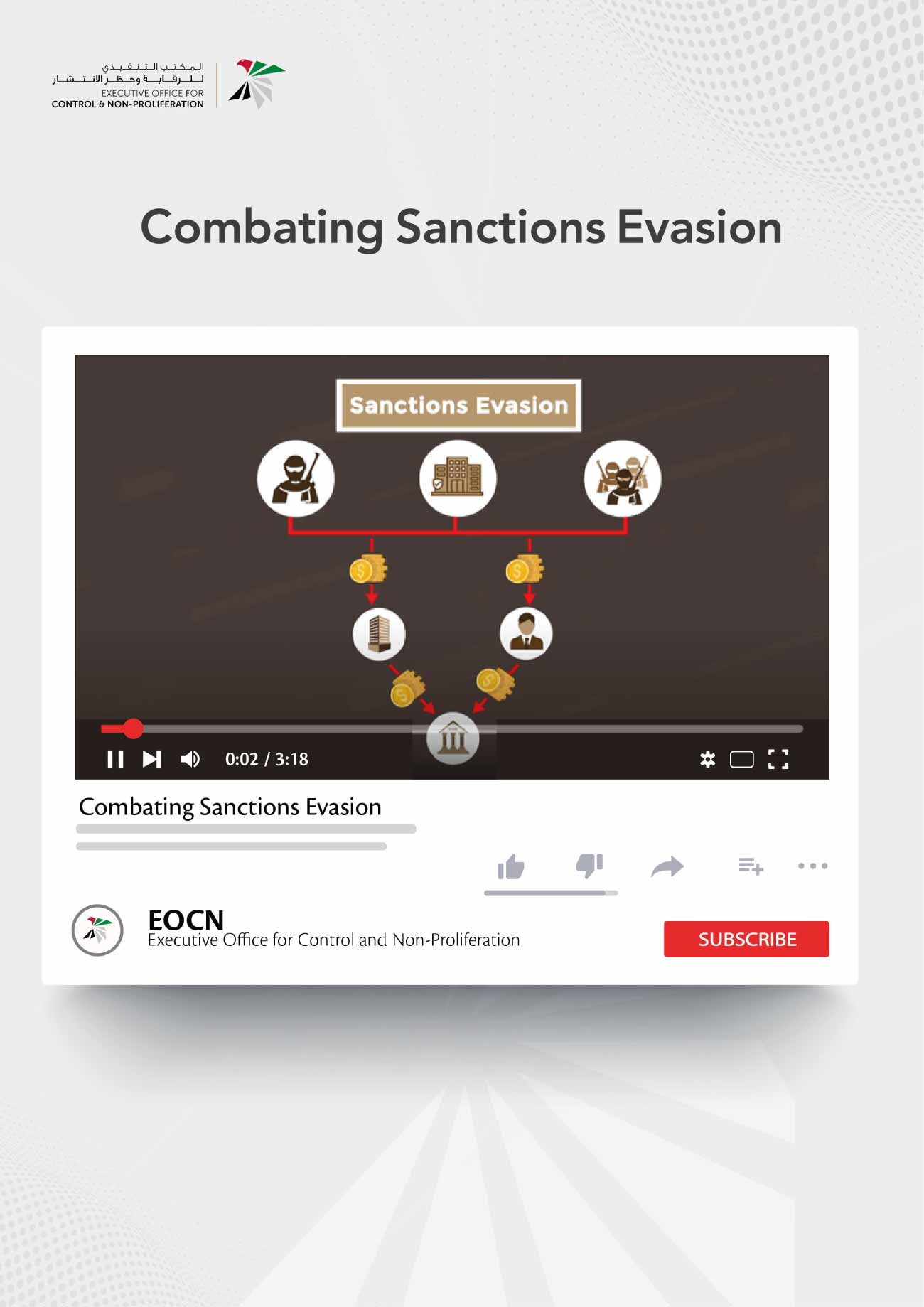
The term “Sanctions Evasion” refers to any attempt to disguise or conceal the involvement of sanctioned individuals, entities, or groups through several evasion techniques, including name changing, using intermediaries or front companies, and utilization of alternative financial networks with aim of accessing funds or other assets.
Reporting Entities should apply proactive measures to identify sanction evasion transactions through understanding the emerging threats and vulnerabilities that can be abused by terrorist financers or proliferators, conducting proper CDD and maintaining up to date sanctions lists, raising awareness of sanction evasion techniques and submitting suspicious PF/TF transactions or activities to the FIU via goAML.
In order to combat sanction evasion schemes, the private sector should work closely with the government sector by building strong partnerships, effective interagency cooperation and sharing of information to assist in tracing, freezing and confiscating funds linked to sanction evasion.
Sanctions Evasion Red Flags and Typologies
The EOCN has prepared a list that includes red flag indicators related to terrorism and proliferation financing. The list aims to assist both the government and private sectors in identifying suspicious transactions or activities associated with sanctions evasion. The EOCN also encourages the private sector to incorporate these indicators into their screening systems as part of their internal controls to combat sanctions evasion related to terrorism and proliferation financing. The main red flag indicators are summarized as follows:
Sanction Evasion Red flags and Typologies - TF
- Carrying out cash withdrawals in short succession (potentially below the daily cash reporting threshold) across various locations in territories where sanctioned people have influence or are in the border of sanctioned countries.
- Funds are sent or received via international transfers from or to higher-risk locations.
- Foreign exchange transactions are performed on behalf of a customer by a third party, followed by funds transfers to locations having no apparent business connection with the customer or to higher-risk countries.
- Multiple personal and business accounts or the accounts of non-profit organizations or charities to collect and funnel funds to a small number of foreign beneficiaries, particularly in higher-risk locations.
- Transactions involve individual(s) or entity(ies) identified by media and/or Sanctions List as being linked to a terrorist organization or terrorist activities.
- An Individual or entity’s online presence supports violent extremism or radicalization.
- Sudden spurt in currency exchange transactions by a group of resident / non-resident customers who could be from similar geographic locations, profession, or age group, who are acting as mules to assist larger cash smuggling groups.
- The use of funds by a non-profit organization is not consistent with the purpose for which it was established.
- Irregularities during the CDD process which could include, but is not limited to:
- Inaccurate information about the source of funds and/or the relationship with the counterparty.
- Refusal to honor requests to provide additional KYC documentation or to provide clarity on the ultimate beneficiary of the funds or goods.
- Suspicion of forged identity documents.
Sanction Evasion Red Flags and Typologies - PF
- Dealings, directly or through a client of your client, with sanctioned countries or territories where sanctioned persons are known to operate.
- The use of shell companies through which funds can be moved locally and internationally by misappropriating the commercial sector.
- Dealings with dual-use (DUG) or controlled goods. For example:
- Chemicals
- DUG (wire nickel, inverters, etc.)
- Dealings with sanctioned goods or under embargo. For example:
- Weapons
- Luxury goods (for DPRK Sanctions)
- Identifying documents that seemed to be forged or counterfeited.
- Identifying tampered or modified documents with no apparent explanation, especially those related to international trade.
- Description of goods on trade or financial documentation is nonspecific, innocuous or misleading.
- A shipment of goods is incompatible with the known business activity and nature of products or services provided by the entities involved in the transaction.
- The activity developed or financed does not relate to the original or intended purpose of the company or entity. For example:
- For companies, they are importing high-end technology devices which is not in accordance with their trade license.
- For a non-profit organization, they are exporting communication devices, but they are an entity aimed to provide humanitarian aid.
- Transactions involved in sale, shipment, or export of DUG is incompatible with technical level of the country being shipped.
- Complex commercial or business deals that seem to be aiming to hide the final destiny of the transaction or the good.
- Complex legal entities or arrangements that seem to be aiming to hide the beneficial owner.
Sanction Evasion Reporting
Reporting Entities should be able to differentiate between cases that require submitting a CNMR/PNMR, and between suspicious transactions and activities that require submitting a STR/SAR.
Any suspicious transactions or activities that might be related to sanctions evasion, and which do not include Confirmed or Partial Name Matches to the Sanctions Lists, should be reported to the FIU by raising a STR/SAR through the goAML platform. The Table below summaries the difference between FFR/PNMR and STR/SAR.
|
Confirmed / Partial Name Match Reports Received by EOCN |
Suspicious Transaction / Activity Reports Received by FIU |
|---|---|
| Confirmed match to a Designated Person | Identified red flags indicators related to TF/PF |
| Partial match to a Designated Person | Does not include confirmed or partial match to a Designated Person |
|
Established legal relationship with a Designated Person or Party (e.g. Power of Attorney) |
Does not involve any established legal relationship with a Designated Person or Party |
Important Note: Designated Person refers to listed persons on the UAE Local Terrorist List or UN Sanction List only.
Transactions Involving Dual-Use Goods
Dual-Use goods is defined as goods that may have both civilian and military uses. These items are generally controlled by governments via export controls, which prevent the export of certain items depending on the end user and end use of the item absent governmental permission.
Cabinet Resolution No. (156) of 2025 contains the list of strategic and Dual-Use goods controlled under UAE law (UAE Control List). The UAE Control List implements internationally agreed Dual-Use goods subject to import and export control, including the Missile Technology Control Regime (MTCR), Nuclear Suppliers Group (NSG), the Wassenaar Arrangement (WA), the Australia Group (AG), the Chemical Weapons Convention (CWC), and the Organization for the Prohibition of Chemical Weapons (OPCW). The UAE Control List is composed of 12 categories based on the technology used. Each category includes a technical description of the items and their control parameters. A summary of the categories can be seen in the table below:
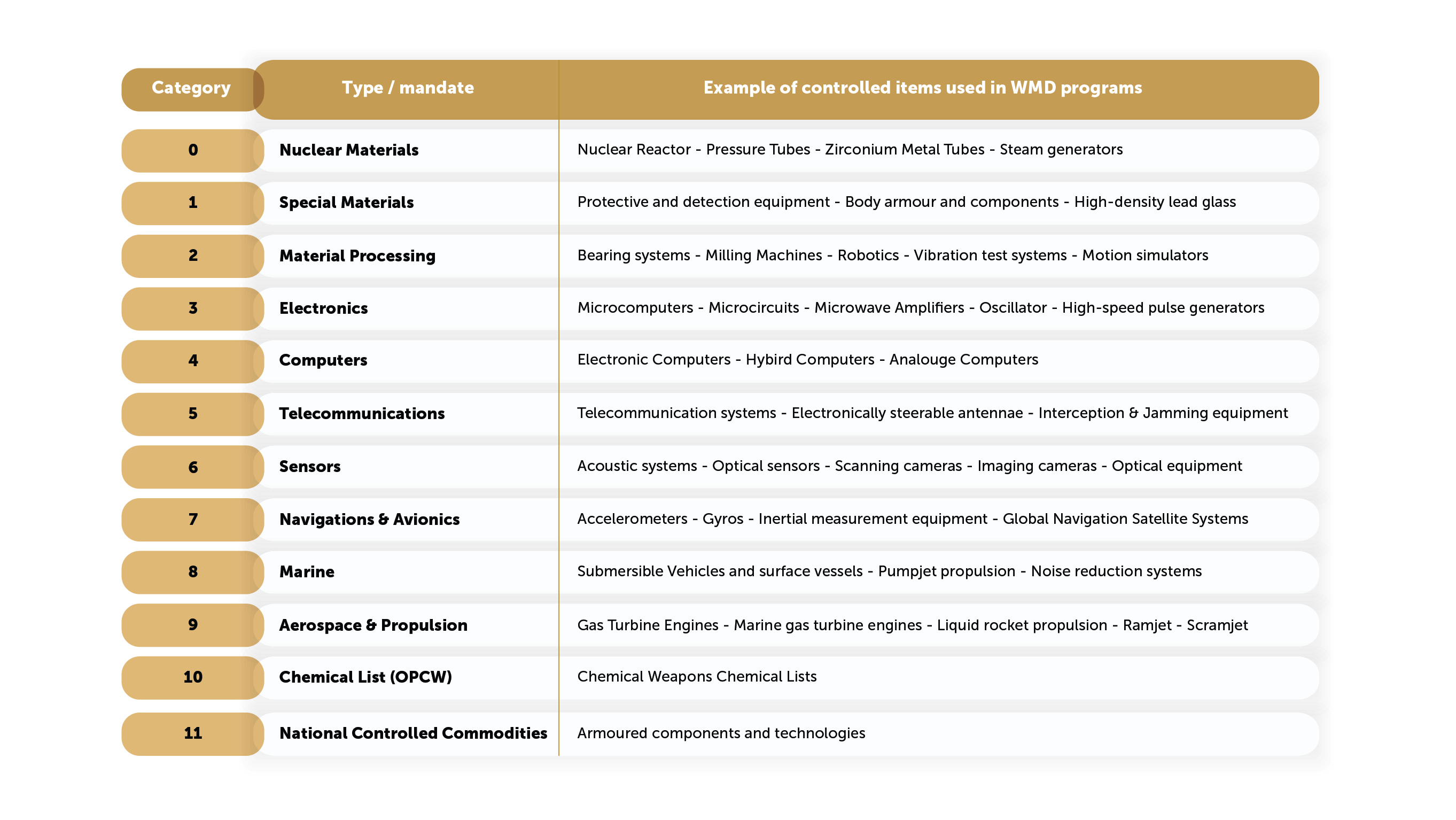
Reporting Entities should be aware that Dual-Use Goods (DUGs) are frequently controlled for export and should attempt to identify DUGs in transactions and provide enhanced scrutiny to such transactions. FIs should screen the UAE Control List (Cabinet Resolution No. 156 of 2025) in trade-based transactions that may involve DUGs, as the import or export of such goods may require a permit from the relevant authorities.
Trade documentation such as bills of lading or letters of credit often do not include the level of detail needed to ascertain whether goods are controlled for export. Nevertheless, private sector entities may be able to detect certain export-related red flags present in transactions. If there is a reasonable suspicion that the goods involved in the transaction could be used in the development, production, or use of products related to WMD, the customer should be required to provide more information about the product, including technical specifications, as well as the end use and end user of the product.
The diagram below provides a process map for dealing with transactions involving DUGs:
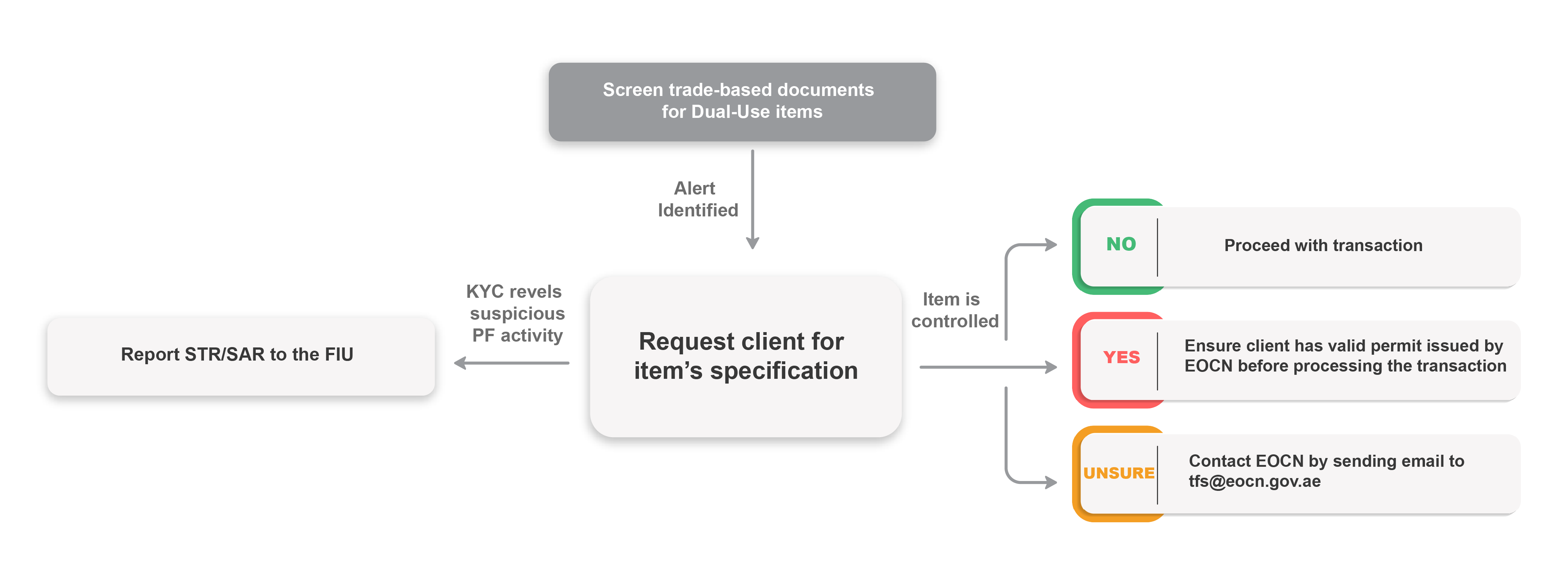
For more details and an example on how to use the Control List, please refer to the Guidance on Counter Proliferation Financing for FIs, DNFBPs, and VASPs in the Online Resources section of the website.
UAE Government Authorities Role
Supervisory Authorities
- Screen the internal data bases against the Local Terrorist List and UN List and take any appropriate action when identifying a match.
- Take freezing measures or any other action to implement TFS.
- Supervise reporting legal entities to verify their compliance with these obligations and measures.
- Apply enforcement actions including administrative fines in case of non-compliance.
Law Enforcement
- Provide any information regarding the outcome of the freezing or implementation of other sanctions, such as travel ban, embargoes, commercial measures, and others within five business days to the Executive Office.
Executive Office for Control & Non-Proliferation (Executive Office).
- Act as a central authority to ensure implementation of Targeted Financial Sanctions in the UAE
- Receive and process grievances against listing in UN and Local Lists decisions
- Receive and process applications to use frozen funds as per Sanctions Lists
- Work closely with the Supreme Council with regard to the local listing.
- Circulate updates to the local and UN lists to the government and private sector
- Coordination and exchange of information between Government Agencies.
Related Links
NAMLCFTGrievances and Requests
Click Here to Submit Grievance Request
Requesting the Removal or De-listing of a Designation from Sanctions Lists
- Individuals and entities designated under the Sanctions Lists may request the removal or de-listing of a designation, as per the procedures detailed below.
Local List
Any individual or entity designated in the Local List can submit a grievance against the designation decision, either personally or through a legal representative. The request for removal or de-listing can also apply for:
- A deceased individual; or
- An entity that no longer exists.
The procedure for requesting the removal or de-listing of a designation from the Local List is the following:
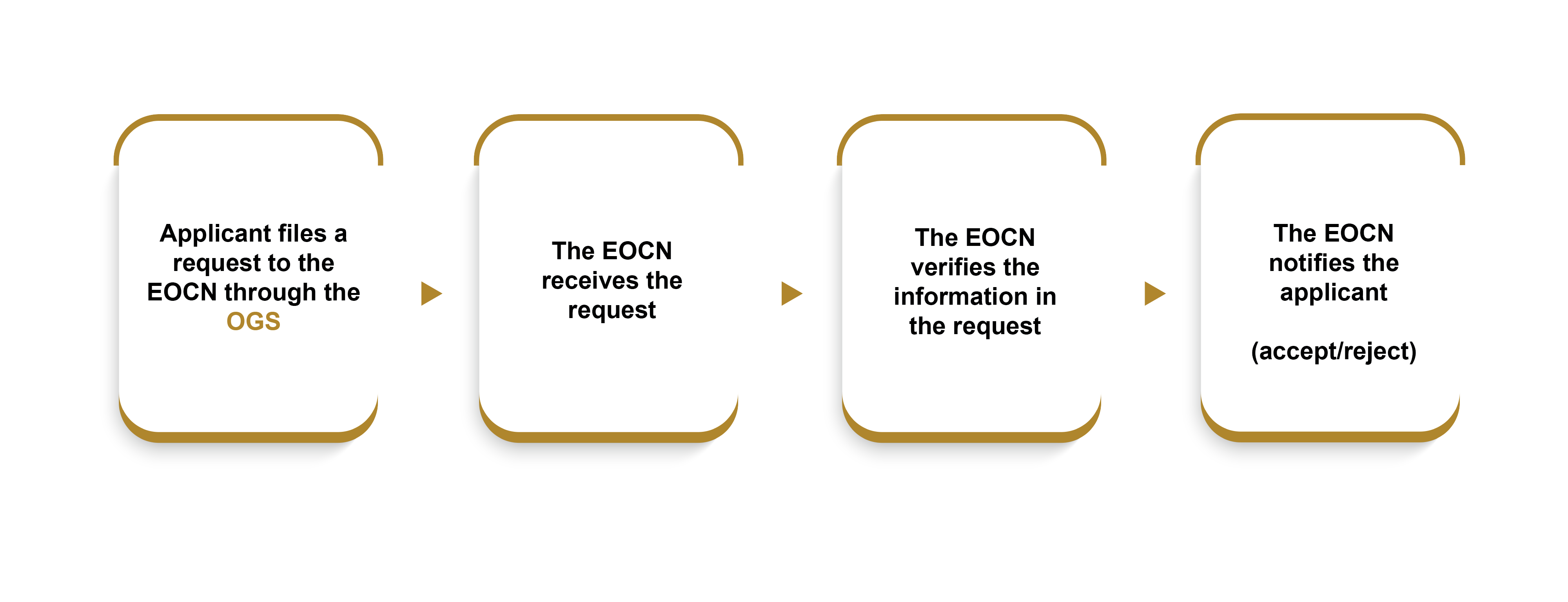
Appeals to the Competent Court: In case the grievance was rejected or remains without a response for sixty (60) days from date of its submission, the applicant may appeal the Cabinet’s designation decision at the Competent Court within sixty (60) days from the date he was notified of the rejection or lapse of the response period.
The Court’s decision regarding the grievance shall not be subject to appeal. If a grievance was rejected, a new grievance may only be submitted after the lapse of six (6) months from date of rejection of the previous grievance, unless a serious reason acceptable to the President of the Court arises before expiry of such period.
An appeal against a designation decision shall not be accepted before a grievance against it is filed and rejected, or before the lapse of the response period.
UN List
Any individual, entity, or group designated by the United Nations Security Council (UNSC) can submit a request for removal or de-listing from the UN List directly to the applicable UNSC Sanctions Committee, following the procedures for submitting de-listing requests pursuant to each UNSC Sanctions Committee. As such, the EOCN does not receive requests to de-list from the UN List and any such requests must be submitted directly to the relevant UNSC Sanctions Committee through the Focal Point process or Office of the Ombudsperson, as detailed below.
Individuals, entities, or groups designated in the UN List can submit de-listing requests directly to the Focal Point for De-listing (except for designated individuals, entities, or groups inscribed on the list of the 1267/1989/2253 Committee (“the ISIL (Da'esh) and Al-Qaida Sanctions List”). Designated individuals or entities seeking to de-list from the Security Council’s ISIL (Da'esh) and Al-Qaida Sanctions List must submit their petition to The Office of the Ombudsperson.
For detailed procedures on the de-listing procedures related to the Focal Point for De-Listing or The Office of the Ombudsperson, refer directly to the United Nations website.
The request for removal or de-listing can also apply for:
- A deceased individual; or
- An entity that no longer exists.
Requesting Cancellation or Lifting of Freezing Measures
Freezing may be cancelled or lifted when taken against an individual, entity, or group who was adversely affected under the following situations:
- An individual, entity, or group that has a name identical or similar to a designated individual, entity, or group;
- The designated individual, entity, or group has been removed / de-listed from the list by the relevant authorities; or
- The individual, entity, or group is a third party acting in good faith who has been adversely or wrongly affected by the freezing measures.
Local List
The procedure for cancellation of freezing taken against an individual, entity, or group due to a designation on the Local List is the following:
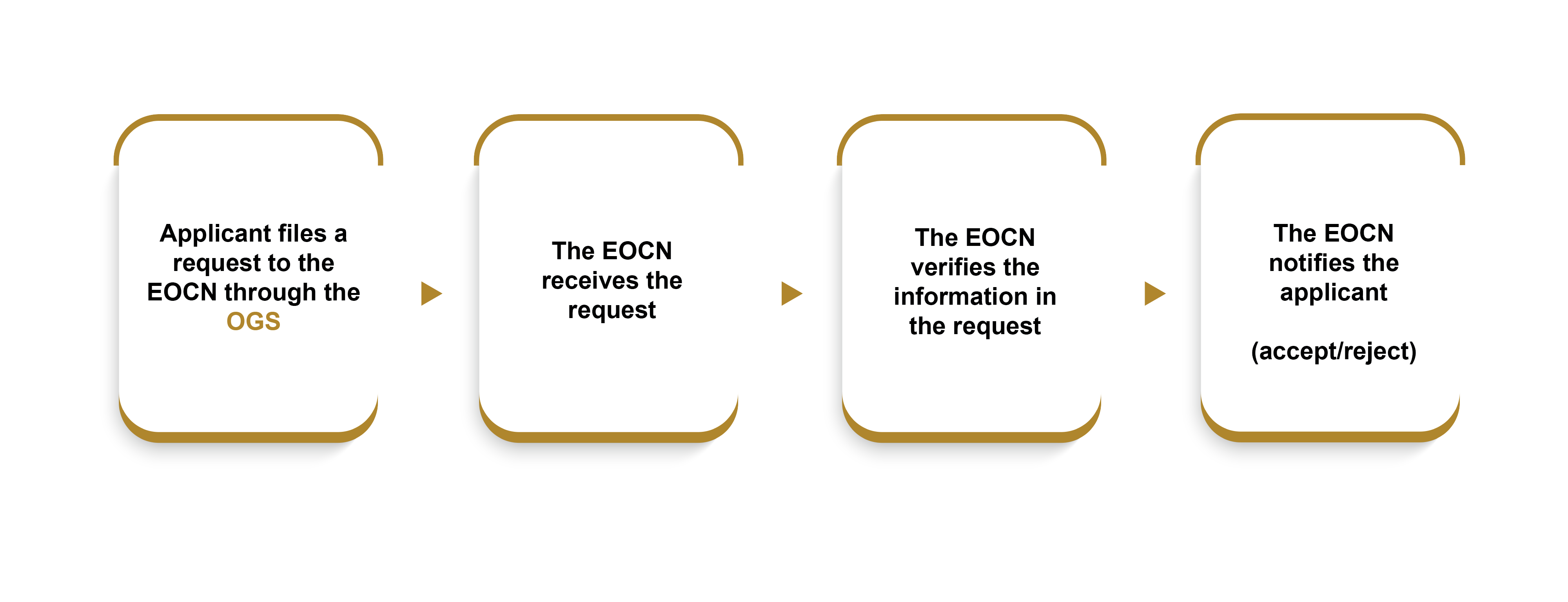
Appeals to the Competent Court: If the application is rejected by the Supreme Council, or if no response to the application is received within thirty (30) days from date of its submission, the applicant may file an appeal at the Competent Court within sixty (60) days from the date of notification of the rejection, or after the response period has elapsed.
The Court's decision on the grievance may not be appealed, and if the Court rules to reject the grievance, a new grievance may only be filed after six (6) months from the date of rejection of the grievance, unless a serious reason that is accepted by the President of the Court arises before the expiry of such period.
An appeal against a decision to apply freezing shall not be accepted before a grievance against it is filed and rejected, or before the lapse of the response period.
UN List
The procedure for cancellation of freezing measures taken against an individual, entity, or group due to a designation on the UN List is the following:
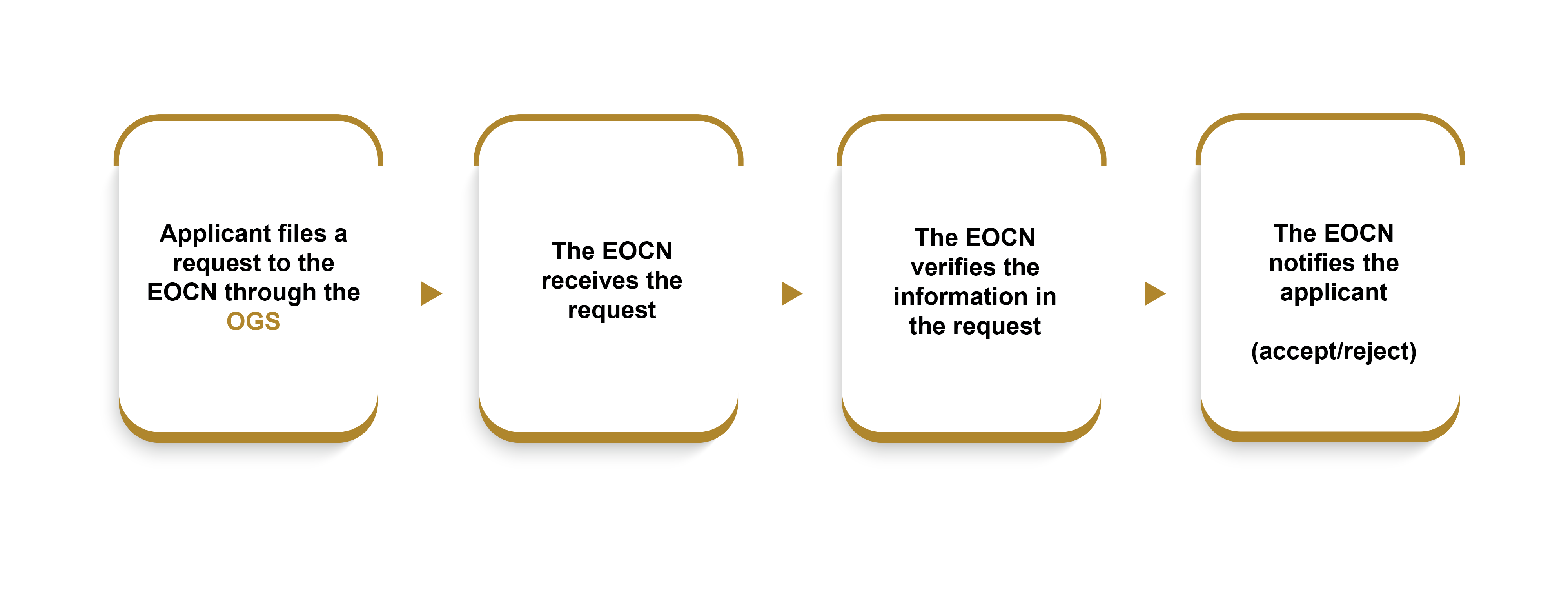
Appeals to the Competent Court: If the request to lift freezing is rejected or remains without a response for thirty (30) days from the date of its submission, the applicant may file an appeal at the Competent Court within sixty (60) days from the date on which he/she was notified of the rejection of the request, or after the response period elapses.
The Court's decision regarding the grievance shall not be subject to appeal. If a grievance is rejected, a new grievance may only be submitted after six (6) months from the date of rejection of the previous grievance, unless a serious reason that is accepted by the President of the Court arises before the expiry of such period.
An appeal against a decision to apply freezing shall not be accepted before a grievance against it is filed and rejected, or before the lapse of the response period.
Requesting Permission to Use Frozen Funds or Other Assets
An individual, entity, or group designated in the Local or UN List, or his/her legal representative, and any stakeholder may request permission to use all or part of the frozen Funds or Other Assets for any of the following purposes:
- To cover necessary or basic expenses, such as the amounts payable for foodstuffs, rent, mortgage, medicine, medical treatment, taxes, insurance premiums, educational and judicial fees, and public utility fees.
- To pay professional fees and costs relating to rendered legal services and other extraordinary expenses within reasonable limits, or services relating to safekeeping or management of frozen Funds or Other Assets.
Local List
The procedure to request permission to use the frozen Funds or Other Assets due to Local List designation is the following:
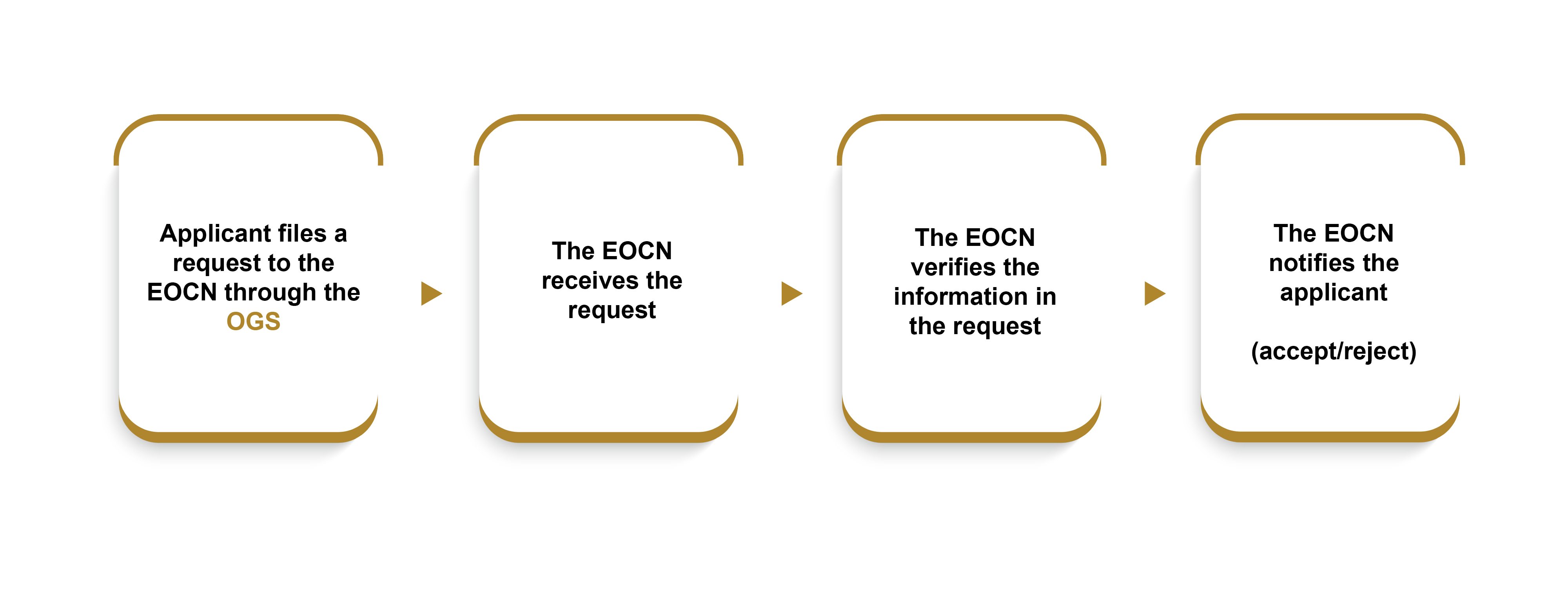
Appeals to the Competent Court: In case the application is rejected, or if no response is received within thirty (30) days from the date of its submission, the applicant may file a grievance at the Competent Court within thirty (30) days from the date when he/she was notified of the rejection, or after the response period has elapsed.
The applicant may not appeal against the rejection of the request until a grievance against it is duly filed and rejected, or the period for responding to it has elapsed.
UN List
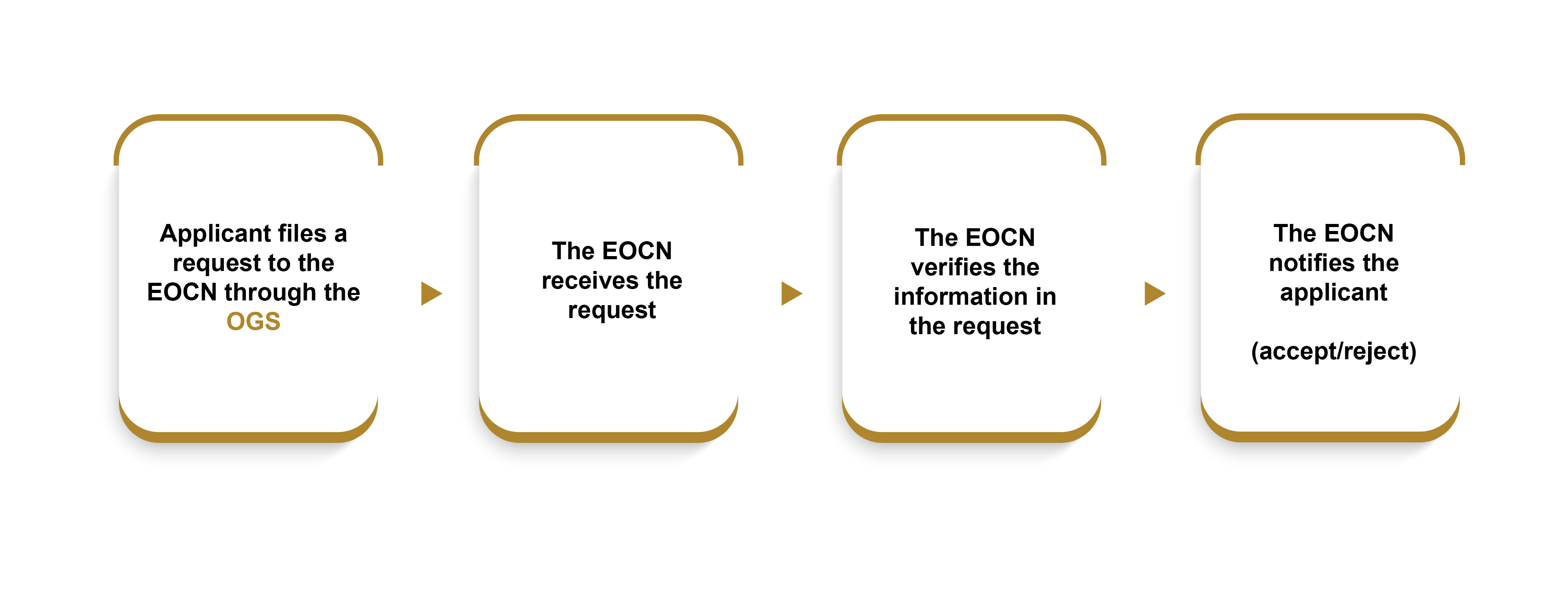
Necessary or Basic Expenses:
The procedure to request permission to use the frozen Funds or Other Assets due to UN List designation to cover necessary or basic expenses is the following:
Extraordinary Expenses:
The procedure to request permission to use the frozen Funds or Other Assets due to UN List designation to cover extraordinary expenses is the following:
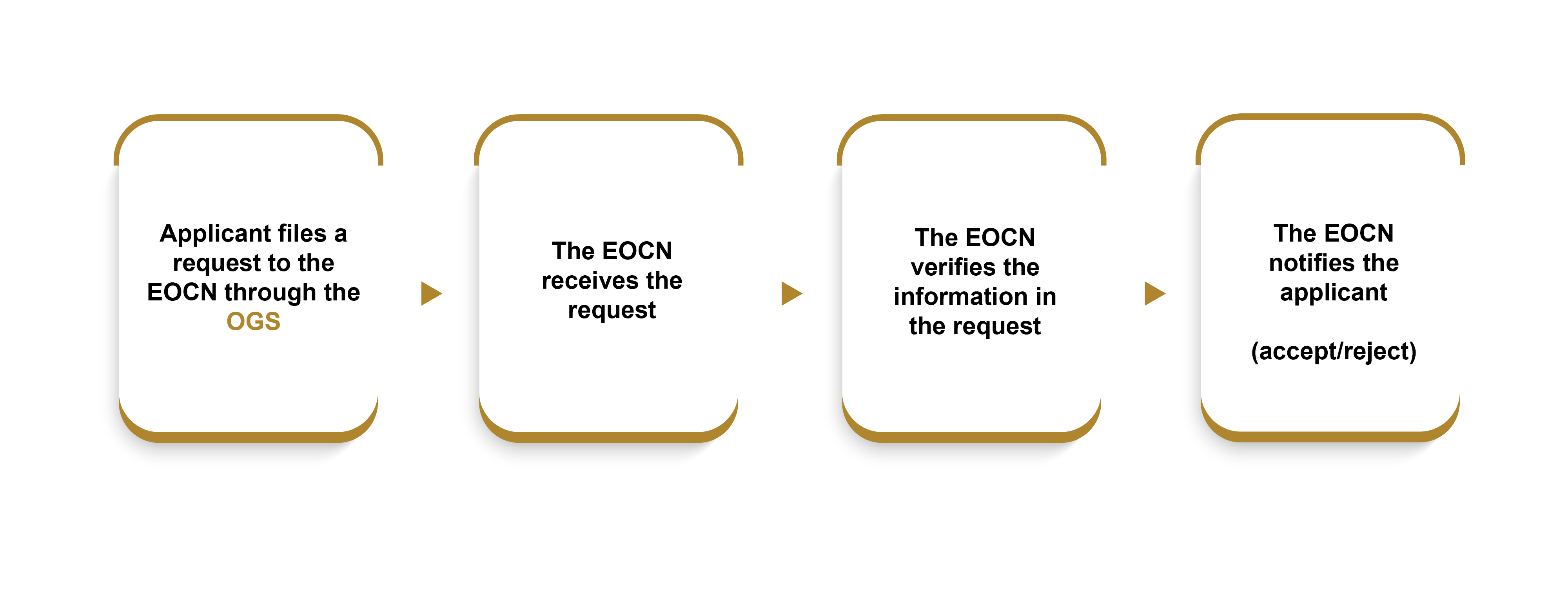
The EOCN may revoke the decision to use funds frozen under the UN List at any time and when having reasonable grounds for a suspicion that the funds are used for financing terrorism or financing proliferation of weapons of mass destruction.
Appeals to the Competent Court: If the application for use of funds frozen under the UN List rejected or remains without response for thirty (30) days from date of its submission, the applicant may file an appeal at the Competent Court within sixty (60) days from the date on which he/she was notified of the rejection of the application, or after the response period elapses.
The Court's decision on the grievance may not be appealed, and if the Court rules to reject the grievance, a new grievance may only be filed after six (6) months from the date of rejection of the grievance, unless a serious reason that is accepted by the President of the Court arises before the expiry of such period.
An appeal against a decision to refuse the use of frozen funds shall not be accepted before a grievance against it is filed and rejected, or before the period given to respond expires.
Documents
Guideline on Grievance Procedures
- , 872.8 KB
Legislation
What does ‘Targeted Financial Sanctions’ ("TFS") mean?
The term targeted sanctions means that such sanctions are imposed against specific individuals, entities, or groups (those designated in the Sanctions Lists). The term TFS includes both asset freezing without delay and prohibition from making funds or other assets or services, directly or indirectly, available for the benefit of sanctioned individuals, entities, or group.
What does 'funds or other assets' mean?
Any assets, including, but not limited to, financial assets, economic resources (including oil and other natural resources), property of every kind, whether tangible or intangible, movable or immovable, however acquired, and legal documents or instruments in any form, including electronic or digital, evidencing title to, or interest in, such funds or other assets, including, but not limited to, bank credits, travellers cheques, bank cheques, money orders, shares, securities, bonds, drafts, or letters of credit, and any interest, dividends or other income on or value accruing from or generated by such funds or other assets, and any other assets which potentially may be used to obtain funds, goods or services.
What is the legal framework for the implementation of TFS in the UAE?
Article 16(e) of Federal Law No. 20 of 2018 (amended by Federal Decree No. 26 of 2021) requires the prompt application of the directives when issued by the competent authorities in the state for implementing the decisions issued by the UN Security Council under Chapter (7) of UN Convention for the Prohibition and Suppression of the Financing of Terrorism and Proliferation of Weapons of Mass Destruction, and other related directives.
In addition, Cabinet Decision No. 74 of 2020 established the framework regarding TFS implementation in the UAE, including implementation of TFS on designated Persons in the UAE Local Terrorist List and UNSC Consolidated List.
Who must comply with implementing TFS measures?
TFS measures must be implemented by any Person (both natural and legal entities), including government authorities and FIs, DNFBPs, and VASPs located in the UAE and operating within the UAE’s jurisdiction.
Is my Supervisory Authority going to check compliance with the Cabinet Decision No. 74 of 2020?
Cabinet Decision No. 74 of 2020 provides that FIs, DNFBPs, and VASPs are under an obligation to have in place adequate processes, policies and procedures, including resourcing thereof, to verify that they are complying with all aspects of the relevant Cabinet Decisions. Supervisory Authorities will verify compliance by FIs, DNFBPs, and VASPs during their supervisory activities. Non-compliance may result in the application of administrative penalties as well as criminal sanctions as stipulated in the Cabinet Decision.
What are the consequences in case of a failure to comply with the obligations set out in Cabinet Decision No. 74 of 2020?
Any Person, found to violate and/or be in non-compliance with the obligation in the Cabinet Decision No. 74 of 2020 or failing to implement procedures to ensure compliance may face imprisonment of no less than one year and no more than seven years and/or a fine of no less than AED 50,000 (fifty thousand dirham) and no more than AED 5,000,000 (five million dirham).
In addition, Supervisory Authorities can impose appropriate administrative sanctions (e.g., ranging from warning letter to license cancellation) when there is a violation or shortcoming in implementing TFS obligations.
Can I be held liable for freezing funds of a designated Persons based on the Cabinet Decision?
Any Person who, in good faith, freezes funds or other assets, or refuses to provide financial services to designated individuals, entities, or groups in compliance with the provisions of Cabinet Decision No. 74 of 2020 shall be exempt from any damages or claims, resulting from such actions, including penal, civil, and/or administrative liability.
Freezing Measures
What is the difference between ‘freezing’ and ‘suspending’?
Freezing and suspension measures follow the same procedures operationally (both are preventive measures that aim to stop the designated individual, entity, or group from gaining access to funds or other assets).
In case the Reporting Entity has come across a ‘Confirmed Name Match’, the term ‘freezing’ is used and the Reporting Entity should apply freezing measures, and it must remain in place until the designated individual, entity, or group is de-listed from the Sanctions Lists or upon a freezing cancellation instruction received from the EOCN.
In case the Reporting Entity has come across a ‘Partial Name Match’ and, after obtaining the ID documentation, is still unsure whether the individual, entity, or group is certainly designated, then the term ‘suspending’ is used and the Reporting Entity should suspend the transaction. Suspension measures should remain in place until further instructions are received from the EOCN on the result of the Partial Name Match (either Confirmed Name Match or False Positive).
When should a transaction be rejected or cancelled?
If a Confirmed Name Match is identified on a potential customer (prospective client) or counterparty, then the Reporting Entity is required to reject the business relationship / transaction and report a CNMR within five business days from rejecting the transaction.
Similarly, in case a Partial Name Match is identified, and the Reporting Entity is unable to obtain an ID document within a reasonable time period (10 business days) to discount or confirm the match, then the Reporting Entity should reject (cancel) the transaction and report a PNMR within five business days from rejecting the transaction.
What does ‘without delay’ mean?
‘Without delay’ means applying freezing measures immediately or in any case within 24 hours upon designation of an individual, entity, or group on the UAE Local Terrorist List or UNSC Consolidated List.
How long do I have to keep funds frozen / suspended?
Freezing applied as a result of TFS measures have no time limits. Asset freezes remain valid until one of the following occurs:
- The designated Person is delisted (removed) from the Sanctions Lists. Upon delisting, all TFS measures are to be lifted immediately without prior approval from EOCN or the relevant SA, unless there is an active Freeze Order related to the delisted Person issued by a Competent Authority (FIU, Public Prosecution, etc.)
- A freezing cancellation decision by EOCN is communicated to the Reporting Entity through goAML.
In case of a Partial Name Match in which the Reporting Entity is unable to verify the match after receiving and reviewing the ID documents and suspension measures were taken, the suspension measures remain until a response is received from the EOCN on the results of the Partial Name Match (either Confirmed Name Match or False Positive).
What should I do if one of my customers is affected by a freezing measure?
You should notify the customer of the Grievances and Requests procedures as reflected on the EOCN’s website. The EOCN has also launched an online platform to receive grievance requests and a User Guide on how to submit a request.
Is notifying the customer after implementing freezing measures considered as “tipping off”?
No.
Reporting Entities may notify their customers after the freezing measures have been implemented. As long as the customer is notified after the freezing measures have been taken, it is not considered as tipping off. However, Reporting Entities must not inform their customers prior to taking the freezing measures.
Can permission be obtained to access frozen Funds or Other Assets by the designated individual or entity?
The EOCN, in certain circumstances, may permit access to frozen funds or other assets based on a grievance request received from the designated Person or his legal representative. Please see the Guidance on Grievance Procedures for more information.
Screening
Can I rely on external service providers to conduct the screening on my behalf?
Reporting Entities may rely on external / third party service providers to conduct screening services on their behalf. However, it is important to note that while such online services are useful, they should not be viewed as an absolute guarantee of compliance with the obligations under the Cabinet Decision and that the ultimate obligation on ensuring compliance with TFS obligations lies with the Reporting Entity. As such, Reporting Entities are advised to do their own checks on the robustness of the screening processes implemented by third party service providers when deciding to utilize their services.
Can I use a manual screening process?
Reporting Entities may use a manual screening process, depending on the size and nature of their business. However, the Reporting Entity should take into consideration factors such as the number of clients, the frequency of transactions, and size of the business when deciding on the appropriate screening process (automated v manual). In any case, the Reporting Entity should ensure that adequate screening measures are set in place to identify and implement TFS measures without delay.
Should I conduct screening during weekends and public holidays?
In cases of weekends and public holidays, Reporting Entities should have appropriate internal procedures to effectively screen against the UAE Local List and the UNSC Consolidated List and prevent access or use of funds or other assets that may be subject to freezing measures. If the Reporting Entity is not conducting any business activities or transactions and where customers do not have access to any assets or accounts during weekends or holidays, then the screening obligation starts from the first minute of commencement of business and freezing measures must be applied immediately. In any case, Reporting Entities should ensure that funds or other assets subject to TFS measures are prevented from being accessed or used.
Reporting
What if my existing customer's name partially matches the name of the designated Person, and I am unable to verify whether it is a Confirmed Match or False Positive?
In case a Partial Name Match is identified on an existing customer, it is assumed that the Reporting Entity already possesses the identification documents of the customer and, after reviewing the ID documents, is unable to conclude whether the match is a Confirmed Name Match or False Positive.
In this case, the Reporting Entity must suspend without delay any transaction, refrain from offering any funds, other assets or services, and submit a PNMR through goAML within five business days from implementing suspension measures. The Reporting Entity must ensure that all necessary information and documents regarding the Partial Name Match are submitted and maintain suspension measures until further instructions are received from EOCN via goAML on whether to cancel the suspension (‘False Positive’) or implement freezing measures (‘Confirmed Name Match’).
What if a potential customer or counterparty’s name partially matches the name of the designated Person, and I am not in possession or unable to obtain the ID documents of the Partial Name Match?
In such cases, the Reporting Entity must first take necessary efforts to obtain identification documents of the potential customer or counterparty to conclude whether the match is a Confirmed Name Match or False Positive. If, after obtaining the ID documents, the Reporting Entity is able to conclude the result as a False Positive, then it may establish the business relation or allow the transaction to proceed without the need to report a PNMR; however, internal documentation of the False Positive result should be maintained.
If the Reporting Entity is unable to obtain the identification documents within a reasonable time (10 business days) of identifying the Partial Name Match, then the transaction or service should be rejected (cancelled) and a PNMR submitted through goAML within five business days from rejection of the transaction or service, specifying that the transaction has been rejected due to lack of ID documents of the Partial Name Match.
Should I report a False Positive Result?
Reporting Entities are not required to report a False Positive result and may allow the business transaction to proceed without notifying the EOCN; however, internal documentation of the screening alert and actions taken need to be maintained.
Should I report previous transactions or business dealings with Confirmed or Partial Name Matches?
CNMRs should also be reported on previous business relationships and transactions occurring and accounts held prior to the designation, covering a timeframe of five years. CNMRs should be submitted even if no current funds or other assets are held by the Reporting Entity and includes accounts closed. In this case, the Reporting Entity is required to clarify in the description of the CNMR that no funds or other assets are currently being held, and there is no current business relationship with the Confirmed Name Match, and the status of the account (closed). The same procedure applies to PNMRs.
If I identify that a customer is subject to unilateral or multilateral sanctions, however, the customer is not listed on the UAE Local Terrorist List nor the UNSC Consolidated List. Should I report it by raising an CNMR or PNMR?
In case any Confirmed or Partial Name Match is identified to a unilateral / multilateral sanctions list or other criminal lists (i.e. OFAC, EU, HMT, INTERPOL, etc.), the Reporting Entity should not use the CNMR/PNMR reports in goAML to report such cases, since CNMRs/PNMRs are used to report matches with the UAE Local Terrorist List and UN List only; however, you should consult with your relevant SA on the appropriate course of action and may consider raising an STR/SAR with the FIU in case a match is identified with other sanctions or criminal lists.
Am I under an obligation to register in goAML?
Any Person (natural or legal) licensed/registered by a SA that performs activities which fall under the definition of FIs, DNFBPs, or VASPs as per UAE legislation has an obligation to register on goAML to be able to submit suspicious transactions/activity reports (STRs/SARs) to the UAE FIU, as well as to submit TFS reports (CNMRs/PNMRs) to the EOCN and the relevant SA.
FIs, DNFBPs and VASPs that are not registered on goAML face the risk of being subject to administrative and/or financial sanctions by the relevant SA for failure to register on goAML.
Please contact your relevant SA and the UAE FIU for instructions on how to register.
How should I report a Confirmed or Partial Name Match if I am not a goAML user?
If you identify a Confirmed or Partial Name Match, and you are not a goAML user (Persons that do not fall under the definition of FIs, DNFBPs, or VASPs and are therefore not under an obligation to register on goAML), then you must report it by sending an email to the EOCN on tfs@eocn.gov.ae with details of the case and attaching all supporting documentation.
Notification Alert System
How can I subscribe to the EOCN Notification Alert System?
To subscribe to the EOCN Notification Alert System, kindly visit the Targeted Financial Sanctions webpage and click on the “Sanctions List and Subscription” icon at the right side of the page to complete your subscription. Please see Annex I: EOCN Notification Alert System Subscription Guide for more details.
What steps should I take if I encounter an error when subscribing?
Try to register again, ensuring that you remove any numbers, dashes, brackets, commas, or symbols from the entity name in both Arabic and English. If you continue to receive a rejection, kindly contact us at tfs@eocn.gov.ae.
How can I unsubscribe from the Notification Alert System?
Please contact tfs@eocn.gov.ae and state the following information:
- Entity name
- Entity subscribed e-mail
- Reason for unsubscribing
UAE Local Terrorist List and UNSC Consolidated List
Which Sanctions Lists are covered under Cabinet Decision No. 74 of 2020 in terms of the requirement to implement TFS?
The scope of Cabinet Decision No. 74 of 2020 in implementing TFS covers the UAE Local Terrorist List and UNSC Consolidated List only.
Other unilateral and multilateral sanctions lists are out of the scope of the Cabinet Decision.
How can I find out who is a designated individual, entity, or group?
You can find out the designated individuals, entities, or groups by checking the updated UAE Local Terrorist List and UNSC Consolidated List in the EOCN website at the links below:
- Local Terrorist List: the link to the UAE Local Terrorist List can be found at the bottom of the Sanctions Implementation webpage on the EOCN website (scroll to the bottom of the page) and is available in both PDF and Excel format. (Click Here)
- UNSC Consolidated List: The UNSC publishes a list of all the sanctioned individuals, entities, or groups designated by the United Nations Sanctions Committees or directly by the UNSC. (Click Here)
Executive Office Publications
UAE Proliferation Financing National Risk Assessment Report
- , 3.3 MB
- , 20 pages
Guidance on Targeted Financial Sanctions
- , 3.1 MB
- , 65 pages
Supervisory Authorities Publications
FATF Guidance Publications
Targeted Financial Sanctions related to terrorism and terrorist financing (recommendation 6)
- , 894.7 KB
- , 21 pages
Sharing Among Domestic Competent Authorities Information Related To the Financing of Proliferation
- , 816.2 KB
- , 14 pages
Training Material
Contact
Send an email to contact the Executive Office for Control & Non-Proliferation to tfs@eocn.gov.ae.
Executive Office For Control Non-Proliferation
Umm Ramool - Dubai CommerCity – Building 01 - 6th Floor
Monday – Thursday: 9:00am – 3:00pm
Friday: 9:00am – 12:00pm
+97142018888
+97143574499
P.O BOX: 3785
tfs@eocn.gov.ae